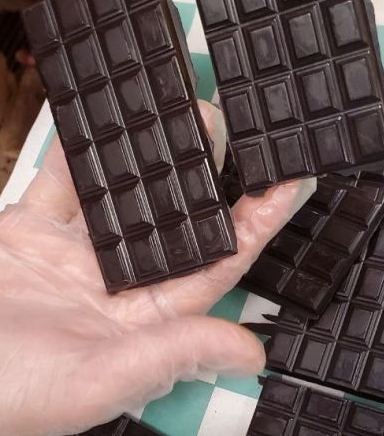
How it feels after eating.
Some chocolate is satisfying and settles easily.
Some feels heavy, sharp, or lingering in a way that is harder to describe.
These differences are usually attributed to sugar content, cocoa percentage, or individual sensitivity.
Those factors matter—but they don’t fully explain the experience.
To understand this, it helps to look at chocolate not just as flavor, but as a physical material.
Chocolate as a Composite
Chocolate is not a single substance. It is a mixture of:
- Cocoa solids
- Cocoa butter
- Residual structural material from the bean
The way these components are processed determines not only taste, but how the chocolate interacts with the mouth and digestive system.
In most chocolate, the starting material includes trace amounts of cocoa shell, carried through the standard separation process.
This is normal. It is part of what defines chocolate as it is commonly made.
Structure and Perception
Before digestion begins in the stomach, chocolate is already being evaluated by the body.
In the mouth, texture and dissolution affect how quickly compounds are released. On the palate, certain structural elements can create sensations like:
- Dryness
- Astringency
- Lingering bitterness
These are often described as flavor, but they are also physical responses.
A more fragmented or mixed material can require more breakdown before it fully dissolves. That changes how the experience unfolds.
A Simpler Starting Material
When chocolate is made from more precisely separated cocoa—where the nib is isolated without residual shell material—the structure changes.
The composition becomes more uniform:
- Fewer fibrous particles
- Less structural variability
- A more direct balance of cocoa solids and cocoa butter
This does not make the chocolate “lighter” in a nutritional sense. But it can change how it behaves as it melts and disperses.
Why This Can Feel Different
A more uniform material can:
- Melt more evenly
- Release flavor compounds more directly
- Leave less residual material on the palate
The result is often described in simple terms:
- “Cleaner”
- “Easier”
- “More satisfying with less”
These are subjective observations, but they tend to be consistent.
Rather than working through layers of texture and finish, the experience resolves more quickly.
The Role of Processing
Other steps in chocolate making also influence how it feels:
- Roasting can introduce or reduce sharpness
- Conching can remove volatile compounds and smooth texture
- Refining affects particle size and mouthfeel
These are well understood.
What is less often considered is how much of that processing is compensating for the starting material.
If the input is more controlled, less adjustment may be required later.
What This Does—and Does Not Mean
It is important to separate observation from interpretation.
- This is not a claim about treating or preventing any condition
- It does not apply the same way to every individual
- It does not replace broader dietary considerations
What it does suggest is that structure matters—not just for taste, but for experience.
Different methods of preparation can lead to different outcomes, even when the ingredient is the same.
A Question of Alignment
Food is often evaluated in two ways:
- How it tastes
- How it feels afterward
In many cases, these are treated as separate concerns.
But they are connected.
A chocolate that is processed in a way that reduces structural interference may align these two experiences more closely, what you taste and how it resolves are more consistent with each other.
Closing
Chocolate is typically described through flavor language: notes, intensity, origin.
But before any of that is perceived, it is encountered as a physical substance.
How that substance is formed, how cleanly it is separated, how uniformly it is structured; shapes not only what you taste, but how the experience concludes.
Some chocolate lingers.
Some resolves.
Understanding why begins not with ingredients, but with how they are defined.