Concerns about heavy metals—particularly lead and cadmium—have brought this issue into focus. But the conversation often stops at the result (what’s detected), rather than the process (how it gets there).
To understand contamination in chocolate, you have to look at the structure of the cocoa bean itself.
The Cocoa Bean Is Not a Closed System
A cocoa bean consists of two main parts:
- The nib, which becomes chocolate
- The shell, which surrounds and protects it
During growth, the nib develops inside the pod, relatively insulated.
The shell, however, becomes exposed during fermentation, drying, and transport.
Once the beans are harvested, the shell is in direct contact with:
- Soil and dust
- Drying surfaces
- Handling and storage environments
By the time cocoa reaches a chocolate maker, the shell reflects everything the bean has encountered along the way.
What Testing Has Shown
Multiple studies and industry analyses have found that:
Cadmium tends to originate within the bean itself, influenced by soil composition
Lead is more often associated with external contamination, particularly on the outer surfaces of the bean
This distinction matters.
It suggests that not all contamination is inherent to cocoa. Some of it is introduced after the bean has been harvested.
Where the Process Matters
Before chocolate is made, cocoa beans are typically roasted, cracked, and mechanically separated from their shells in a process known as winnowing.
This step is efficient, but not absolute.
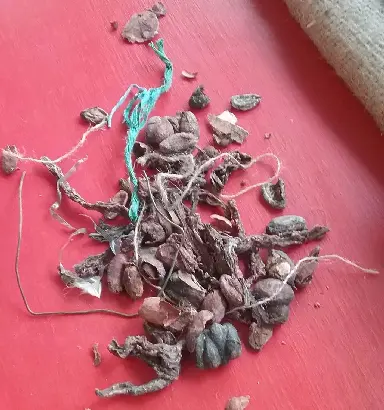
- The shell is broken into fragments
- Airflow separates lighter shell from heavier nib
- Small particles of shell remain mixed with the nib
This is standard across the industry. It is not considered a defect.
But it means that any substances associated with the shell, whether environmental residues or surface contaminants, can remain in the material that becomes chocolate.
The Role of the Shell
The shell is not just a protective layer. It is also a point of contact.
If lead or other contaminants are present on the surface of the bean, they are more likely to be associated with the shell than with the interior nib.
When shell fragments remain after processing, they introduce a pathway—however small—for those external elements to persist in the final product.
This does not mean all chocolate is unsafe. It means the process allows for variability.
A Different Approach to Separation
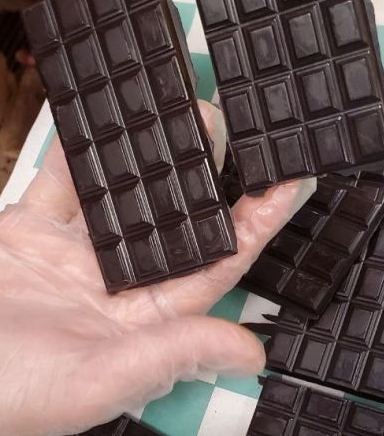
Some chocolate is made using a more controlled method of separation: hand-shelling.
Instead of cracking beans in bulk and separating them mechanically, each bean is opened and cleared manually. The nib is removed intact, and the shell is discarded completely.
This approach does not change what is inside the nib itself. It does something more specific:
It reduces the possibility that shell-associated material carries forward into the finished chocolate.
What This Does—and Does Not Do
It’s important to be clear about the limits of process.
- It does not eliminate naturally occurring elements within the cocoa bean
- It does not guarantee zero contamination
- It does not replace the need for testing and sourcing awareness
What it does is remove a variable that is otherwise accepted:
Residual shell material.
By starting with a more precisely separated ingredient, the chocolate maker has greater control over what is—and is not—carried into the final product.
Why This Is Rarely Discussed
Most conversations about contamination focus on origin: where the beans were grown, what the soil contains, how they were handled.
These are important factors.
But the separation step—how the nib is isolated from the shell—is often treated as a technical detail rather than a defining variable.
In reality, it is one of the last points at which external material can be excluded.
A Matter of Control
Chocolate cannot be reduced to a single variable. It is the result of many stages, each with its own constraints.
But not all variables are equally visible.
The presence of trace contaminants is measurable. The pathway by which they enter the product is less often examined.
Understanding that pathway does not require alarm. It requires clarity.
Closing
Chocolate begins long before it is ground and conched. It begins with how the bean is handled, separated, and defined.
Contamination, when it occurs, is not abstract. It follows physical routes.
One of those routes runs through the shell.
How completely that shell is removed is not just a technical detail.
It is a decision about control.