These distinctions are real, but they all exist within a shared framework. The beans may differ, but the way they are processed is largely the same.
Across the industry, from industrial producers to craft makers, chocolate begins from a common baseline:
beans are roasted, cracked, and mechanically separated from their shells.
That baseline defines what chocolate is allowed to taste like.
Rarity Is Usually Misunderstood
When people talk about rare chocolate, they usually mean one of two things:
Rare beans (limited origin, heirloom varieties)
Limited production (small batches, seasonal releases)
Both are forms of scarcity. Neither necessarily changes the structure of the chocolate itself.
A rare bean processed conventionally will still taste like chocolate as we know it, just with variation inside a familiar range.
Rarity, in this sense, is about inputs, not outcomes.
A Different Kind of Rarity
There is another kind of rarity that is almost never discussed:
Not what the beans are, but what has been removed from them.
Before chocolate becomes chocolate, the cocoa bean is separated from its shell. In standard production, this is done mechanically, and small amounts of shell material remain.
This is not considered a flaw. It is the accepted condition of chocolate.
But it means that nearly all chocolate shares a subtle, underlying commonality, an inherited layer that shapes texture and finish, regardless of origin.
Subtractive Rarity
If rarity is defined by what is present, most chocolate competes on sourcing.
If rarity is defined by what is absent, the frame changes.
Chocolate made from fully hand-shelled beans—where the nib is completely separated and no residual shell material remains—begins from a different starting point.
This is not a matter of refinement. It is a matter of subtraction.
- No fragmented shell particles
- No mixed material
- No reliance on mechanical separation
What remains is a narrower, more controlled ingredient.
This kind of chocolate is rare not because the beans are scarce, but because the process removes something that is almost always left in.
Why This Affects Taste
Flavor is not only created, it is also filtered.
In conventional chocolate, trace shell content contributes structure:
- dryness,
- astringency,
- and a certain weight in the finish.
These are subtle, but they are consistent across most chocolate.
When that layer is removed, the flavor does not become louder. It becomes more direct.
- Notes appear with less resistance
- Transitions between flavors are clearer
- The finish resolves without the same lingering interference
This is not a new flavor profile. It is a different level of access to the existing one.
The Smallest Category
There are thousands of chocolate makers in the world.
There are far fewer who control fermentation.
Fewer still who roast with precision.
And almost none who redefine the material before processing begins.
Chocolate made from fully hand-shelled beans exists in an extremely small category—not widely named, not standardized, and not scaled.
It is not a recognized tier like “bean-to-bar.”
It is closer to an unspoken deviation from it.
What Makes It Rare
Rarity, in this case, is not a marketing claim. It is a consequence of constraints:
- It cannot be produced quickly
- It cannot be produced at large scale
- It cannot rely on conventional machinery
Every unit requires direct, manual intervention at the level of the individual bean.
That constraint limits output—and defines the category.
What You Are Actually Tasting
When people describe chocolate as “rare,” they often mean they are tasting something unfamiliar.
But unfamiliarity can come from novelty.
Rarity, in a stricter sense, comes from removing what is normally there.
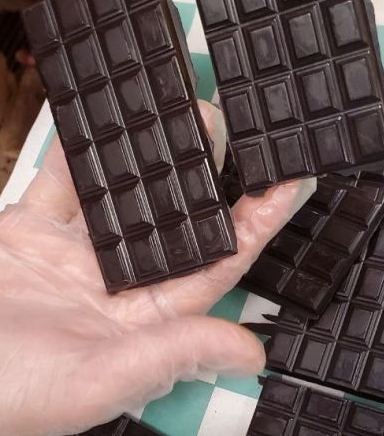
The result is not a different kind of chocolate in appearance.
It is a different relationship to the same material.
- Less interpretation.
- Less interference.
- A shorter path between the bean and the experience.
Closing
Most chocolate explores variation within an accepted structure.
Rare chocolate, in the conventional sense, pushes the edges of that structure.
But the rarest-tasting chocolate may not come from pushing further outward.
It may come from starting somewhere else entirely.