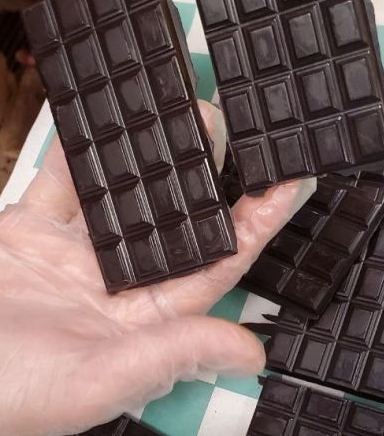
By the time it becomes a finished bar, it is the result of dozens of decisions.
But those decisions are built on a starting point that is rarely questioned.
The Assumption
Across the chocolate industry, there is a shared assumption:
That once the cocoa bean has been roasted, cracked, and separated from its shell, it is ready to be made into chocolate.
This step—winnowing—is treated as complete.
It is not.
The Standard Process
In conventional chocolate making, roasted beans are broken into fragments. Airflow is then used to separate the lighter shell from the heavier nib.
This works efficiently at scale.
But it produces a mixed result:
Most of the shell is removed
Some of it remains
This is not considered a flaw. It is considered acceptable.
And because it is accepted, everything that follows is designed to work with it.
Building on an Imperfect Base
Once the nib fraction is established, the rest of the process begins:
- Roasting develops flavor and helps loosen shells
- Grinding and refining reduce particle size and create uniformity
- Conching removes volatile compounds and smooths texture
These steps are often described as craftsmanship.
But they also serve another function:
They compensate.
They take a material that contains mixed elements and attempt to resolve it into something cohesive.
What Is Being Managed
When shell fragments remain in the starting material, they introduce variables:
- Fibrous structure that resists breakdown
- Dryness and astringency in the finish
- Additional compounds that must be reduced or masked
These are subtle effects. They are rarely isolated or discussed directly.
Instead, they are absorbed into the definition of what chocolate “is.”
Refinement as Correction
Much of what is considered refinement in chocolate making can be understood as a response to this starting point.
- Longer conching times.
- Higher levels of processing.
- Adjustments to smoothness and balance.
These are not arbitrary techniques. They are solutions.
But they are solutions applied after the fact.
A Different Starting Point
If the initial separation were more precise—if the nib were fully isolated from the shell before processing begins—the role of these later steps would change.
- Less would need to be corrected.
- Less would need to be removed.
- Less would need to be smoothed over.
The process would shift from compensation to expression.
Why This Matters
Chocolate is often evaluated at the end of the process:
- How smooth it is.
- How complex it tastes.
- How long the finish lasts.
But these qualities are shaped much earlier.
If the starting material contains elements that are only partially removed, the entire process is influenced by that condition.
The result may still be excellent.
But it is built on a compromise.
Why It Persists
The current approach is not the result of oversight. It is the result of optimization.
Mechanical separation is:
- Fast
- Scalable
- Consistent
It allows chocolate to be produced in large quantities with predictable results.
Changing that step would change everything that depends on it.
Rethinking “Correct”
To say that most chocolate is processed incorrectly is not to say that it is poorly made.
It is to question whether the foundational step—the definition of the raw material—is as precise as it could be.
If a process begins with an incomplete separation and relies on later stages to resolve it, it is effective.
But it may not be optimal.
Closing
Chocolate is a product of many refinements layered on top of one another.
But refinement assumes something has already been defined.
If the material itself is only partially separated at the beginning, then everything that follows is working within that limitation.
Reconsidering that first step does not require changing the entire process.
It requires recognizing where the process actually begins.