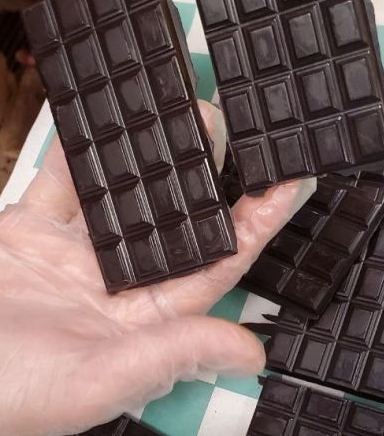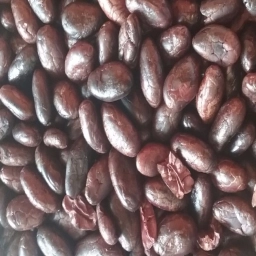
That the cocoa bean has already been properly separated from its shell.
In most modern chocolate production, that separation happens through winnowing, a mechanical process that cracks roasted beans and uses air to blow away the lighter shell fragments. It is efficient, scalable, and imperfect.
And that imperfection defines the baseline of nearly all chocolate.
The Hidden Variable: The Shell
The cocoa bean is not a uniform ingredient. It is a composite:
- The nib, which contains cocoa solids and cocoa butter
- The shell, a fibrous outer layer exposed to fermentation, drying, transport, and handling
By the time beans reach a chocolate maker, the shell has absorbed environmental contaminants and physical residues from every step of its journey. Winnowing removes most of it—but not all.
Small shell fragments remain embedded in the nib fraction. This is not considered a defect. It is considered normal.
Chocolate, as commonly made, is built on that tolerance.
What Hand-Shelling Actually Does
Hand-shelling rejects that tolerance.
Instead of cracking beans and separating them in bulk, each bean is opened and cleared manually. The nib is removed intact. The shell is discarded completely.
This is not a refinement of winnowing. It is a different philosophy:
- No fragmentation
- No mixed fractions
- No reliance on air separation
- No residual shell material
The result is not just “cleaner” chocolate. It is a different starting material.
Why This Changes Flavor
Chocolate flavor is often described in terms of origin: fruit, earth, spice, acidity. But those flavors are mediated by everything that happens before grinding begins.
When shell material is present, even in small amounts, it contributes:
- Dryness
- Astringency
- Burnt or papery notes (especially after roasting)
These are not dominant flavors. They are structural ones. They shape the finish.
Removing the shell entirely changes that structure. The chocolate can present:
- A more direct expression of cocoa solids
- A cleaner finish without residual bitterness
- Greater clarity between flavor notes
This is not about making chocolate smoother in the conventional sense. It is about removing interference.
Why This Changes Processing
Once the shell is gone, other steps behave differently.
Roasting, for example, is often used in part to make shell removal easier. When that constraint disappears, roasting can be approached more selectively—less as a mechanical aid, more as a flavor decision.
Grinding and refining also shift. Without fibrous shell particles, the texture is not governed by the same constraints. The goal is no longer to break down a mixed material into uniformity, but to preserve the integrity of a cleaner one.
Even conching, the extended mixing process used to drive off volatile compounds, takes on a different role. If fewer unwanted elements are present at the start, less aggressive processing is required to remove them.
Why This Is Rare
Hand-shelling is not uncommon because it is unknown. It is uncommon because it does not scale.
It requires:
- Greater clarity between flavor notes
- Time per bean, not per batch
- Direct handling instead of mechanization
- Acceptance of extremely low throughput
Modern chocolate production is optimized around efficiency—tons per day, not pounds per batch. Winnowing is compatible with that system. Hand-shelling is not.
The result is that nearly all chocolate, from industrial to craft, shares the same initial compromise.
A Different Baseline
Most discussions about chocolate quality begin after winnowing. Differences in origin, fermentation, roasting, and conching are layered on top of a material that already contains residual shell content.
Hand-shelling changes the baseline itself.
It does not guarantee better chocolate. It does something more specific:
- It removes a variable that is usually accepted as unavoidable.
From that point forward, every decision—roast, grind, conch—operates on a different foundation.
What You Taste
The effect is subtle at first, then cumulative.
Not a single dramatic note, but an absence:
- Less interference in the finish
- Less need to “work through” bitterness
- A shorter distance between aroma and taste
- It is the difference between tasting through something and tasting directly.
Closing
Chocolate is often described as a product of origin and craft. But before either can express themselves, the material itself has to be defined.
Most chocolate begins with a mixture that includes traces of everything the bean has encountered.
Hand-shelling begins with a decision to remove that mixture entirely.
Everything that follows comes from that choice.